

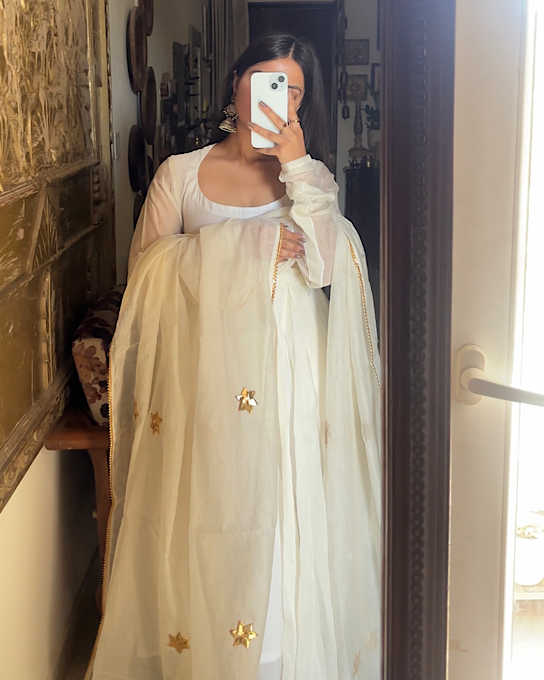
The Art of Gota Patti: Jaipur's Metallic Embroidery Tradition
Look closely at the neckline or hem of an anarkali or occasion-wear set, and you'll often find gota patti — a raised, metallic trim made from gold or silver ribbon, folded and stitched into floral and geometric motifs. It's one of Rajasthan's most recognizable embroidery techniques, and one of the most labor-intensive.
What gota patti actually is
"Gota" refers to a narrow woven ribbon, traditionally made with real gold or silver thread, though most modern gota uses metallic-coated yarn. "Patti" means strip or patch. Artisans cut the ribbon into small shapes — petals, leaves, paisleys — fold the edges under by hand, and stitch each piece onto the fabric one at a time to build a raised, dimensional pattern.
Why it takes so long
A single gota patti border can involve hundreds of individually folded and stitched pieces. Unlike printed or machine-embroidered trims, gota sits slightly above the fabric surface, catching light differently depending on the angle — which is why it reads as more textured and formal in person than in photos.
Where you'll find it in our collection
We use gota patti sparingly, mostly on chanderi and cotton anarkali sets meant for celebrations, pairing it with hand block print or plain chanderi so the embroidery stays the focal point rather than competing with a busy print.
Explore our anarkali and occasion wear sets finished with hand-stitched gota patti detailing.